
SECTION 04 / 10
Chebyshev’s inequality
On this page 6 headings
Learning goal: Use mean and variance to bound deviations on both sides.
Conditions to check
- The variance must be finite.
- The standard-deviation form assumes positive standard deviation; if the variance is zero, the variable equals its mean almost surely.
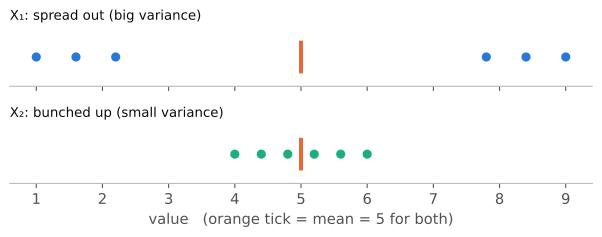
- The ideaTwo classes both average 50 %.
- In one, everyone scored between 45 and 55.
- In the other, scores range from 0 to 100.
- If you also know how spread out the scores are, you can make a much sharper statement about how many are far from 50.
- Chebyshev does exactly that.
Key statementTwo random variables (points far apart) and (points bunched together) with .
Chebyshev's inequalityFor any random variable X with finite mean and finite variance , and any :
Reading the formula
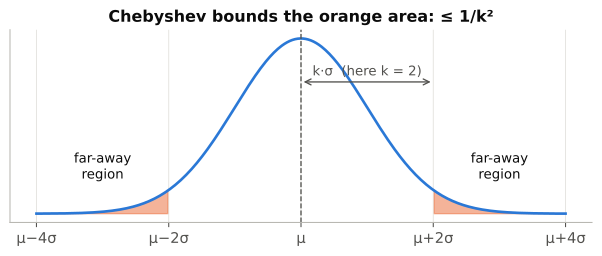
is how far the outcome lands from the average, on either side.
That is why there is an absolute value.
- means "k standard deviations away".
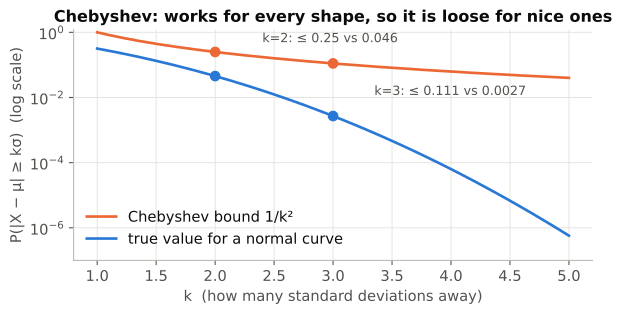
- The chance of being at least k standard deviations away is at most : at most 25 % for k = 2, 11.1 % for k = 3 and 4 % for k = 5.
- Unlike Markov, X may be negative, and the bound works on both tails at once.
- For k ≤ 1 the bound is ≥ 1, so it says nothing.
Why it is true (Chebyshev = Markov in disguise)
- Let .
- Y is never negative, and .
- The event "" is the same event as "".
- Apply Markov to Y:
Worked example 1: exam scores
- Mean 70, standard deviation 10.
- At most what fraction scored below 50 or above 90?
- Being 20 away is standard deviations, so the bound is .
- At most 25 %, for any score distribution with this mean and spread.
- If the scores happen to be normal, the true figure is about 4.6 %.
Worked example 2: the die again
- , .
- What is the chance of landing 2.5 or more from 3.5, which means rolling a 1 or a 6?
- , so Chebyshev gives .
True: .
The bound holds.
Check yourself
Mean 100, σ = 15. Upper bound on P(X ≤ 55 or X ≥ 145)?
45 away means k = 3, so the bound is 1/9 ≈ 0.111.
What is the bound for k = 0.5, and why is it useless?
- 1/0.25 = 4.
- Any probability is at most 1 anyway, so a bound of 4 says nothing.
Key points to remember
- Measure distance from the mean, including both tails.
- Variance divided by squared distance gives the bound.
- No normal-distribution assumption is required.