
2025 T2 Quiz 1Q964 marks
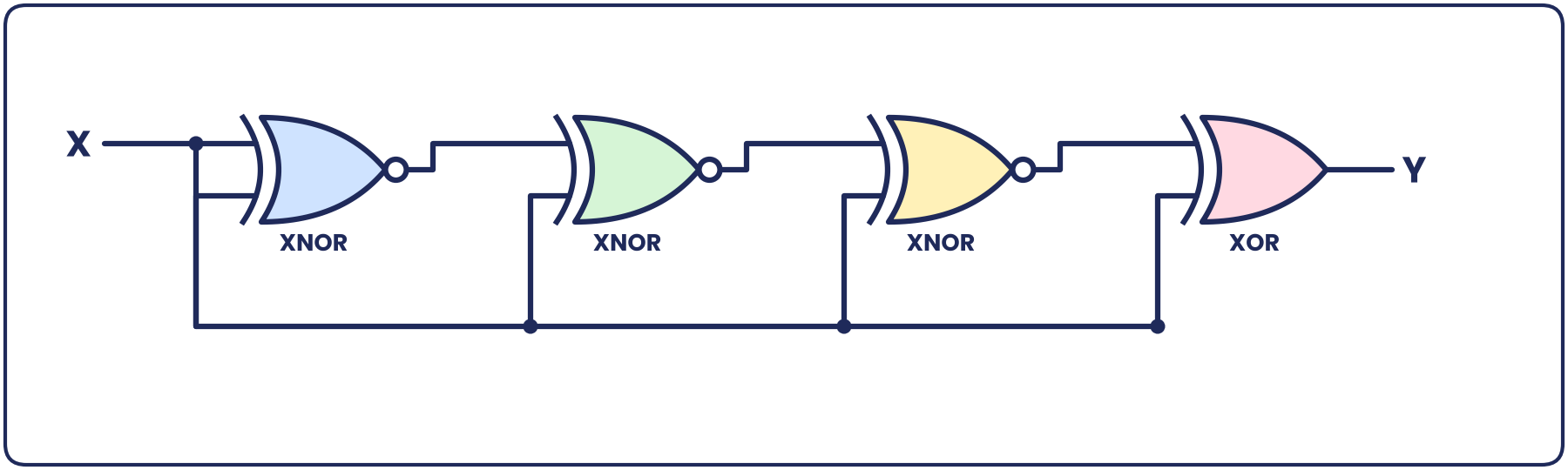
Question: X feeds a chain: XNOR → XNOR → XNOR → XOR. Each gate’s second input is X. What is the output Y? Options:
Show solution
- G1 = 1
- G2 = G1 ⊙ X
- G3 = G2 ⊙ 1
- G3 ⊕
- Check with ✔
20 of 20 questions shown
Start here Every Week 2 question from the 11 past papers is on this page, with the exact paper it came from. For each type you first learn the method from zero, then you see every real question solved step by step, writing out every line. Three official answer keys turned out to be wrong. Those are marked so you don’t get confused.
How to read this page: each grey “Asked in” box is a real past-paper question, with the paper, question number and marks. Below it, How to solve shows every step.
Work one gate at a time, from left to right. Write each gate’s output in terms of the input. Use these rules:
| Rule | Why |
|---|---|
| same inputs → XOR says “not different” (0), XNOR says “same” (1) | |
| XOR with 1 flips | |
| XNOR with 0 flips | |
| AND with 1 gives X, then flip |
Level 1: one gate. XOR with both inputs 0. Level 2: two gates. G1 = , then G2 = .
Check trick: put , then , and push the numbers through. If you get 1, 0 → the answer is . If you get 0, 1 → X.
Question: X feeds a chain: XNOR → XNOR → XNOR → XOR. Each gate’s second input is X. What is the output Y? Options:
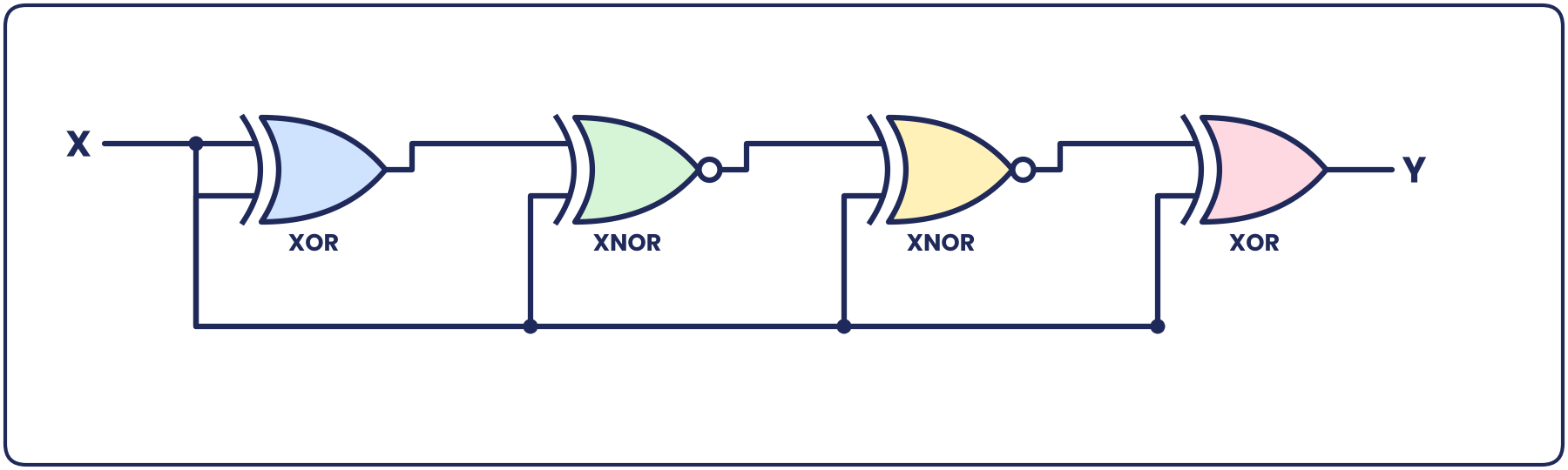
Question: X feeds a chain: XOR → XNOR → XNOR → XOR. Each gate’s second input is X. What is the output? Options:
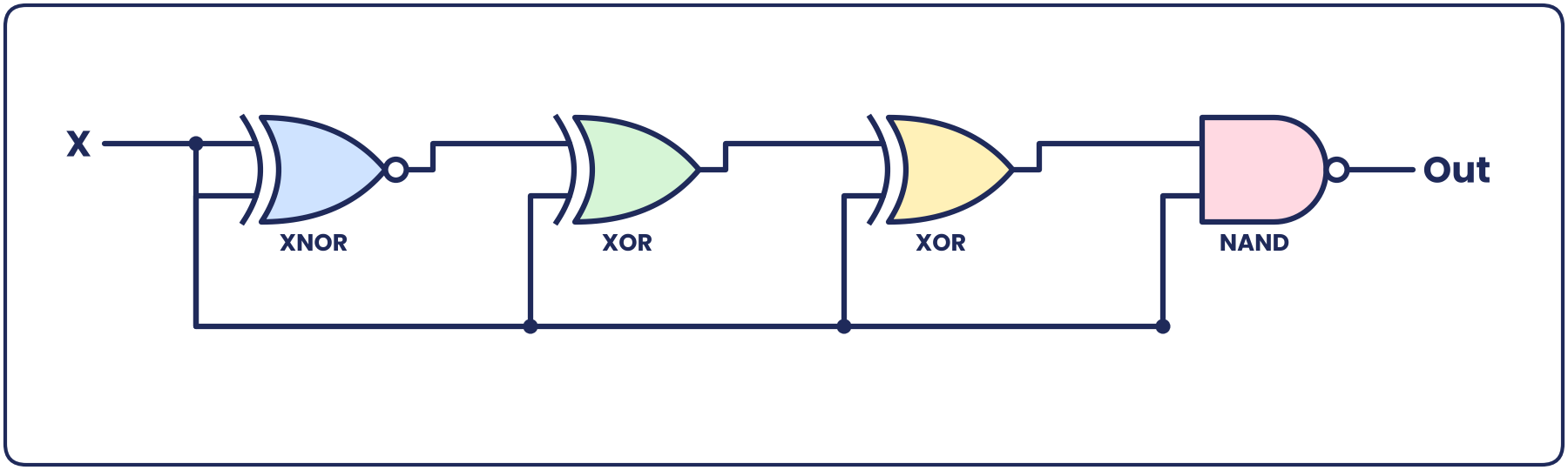
Question: X feeds a chain: XNOR → XOR → XOR → NAND. Each gate’s second input is X. What is the output? Options:
“Inputs are uniformly random” means every row of the truth table is equally likely.
P(output = 1) = (number of rows where output = 1) ÷ (total rows)
Total rows = 2ⁿ for n inputs: 3 inputs → 8 rows, 4 inputs → 16 rows.
Level 1: . Only row 11 gives 1. 0.25. Level 2: . Rows 01, 10, 11 give 1. 0.75. Level 3: big circuits. First simplify the circuit to a formula, then count. A big circuit often simplifies to just one letter, and then .5.
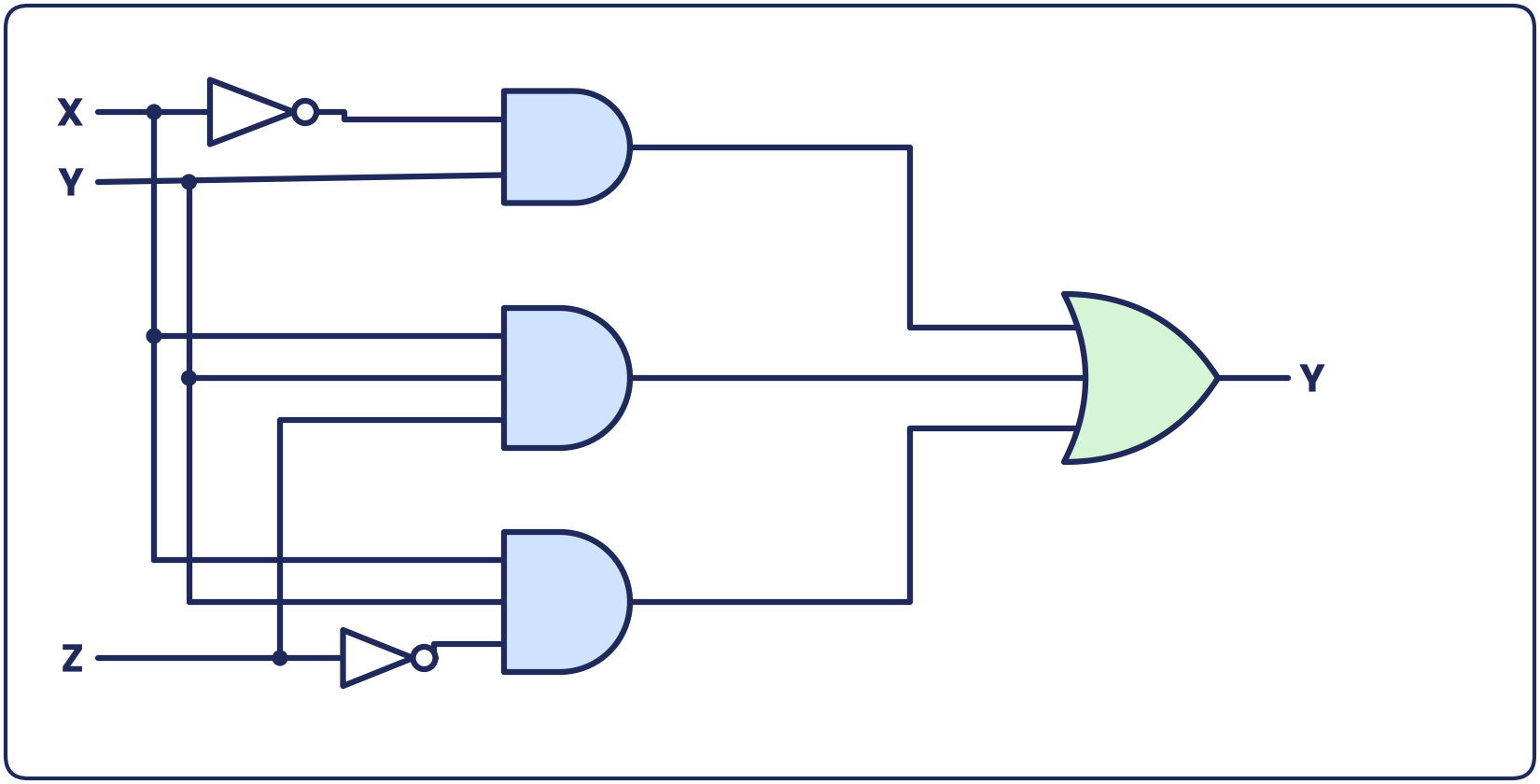
Question: X and Y go into an XOR. Separately, X and Y go into an AND. The XOR output and Z go into a second AND. Both AND outputs go into an OR → F. Inputs are uniformly random. ? Options: 0.75 / 0.33 / 0.25 / 0.50 / 1 / None of these
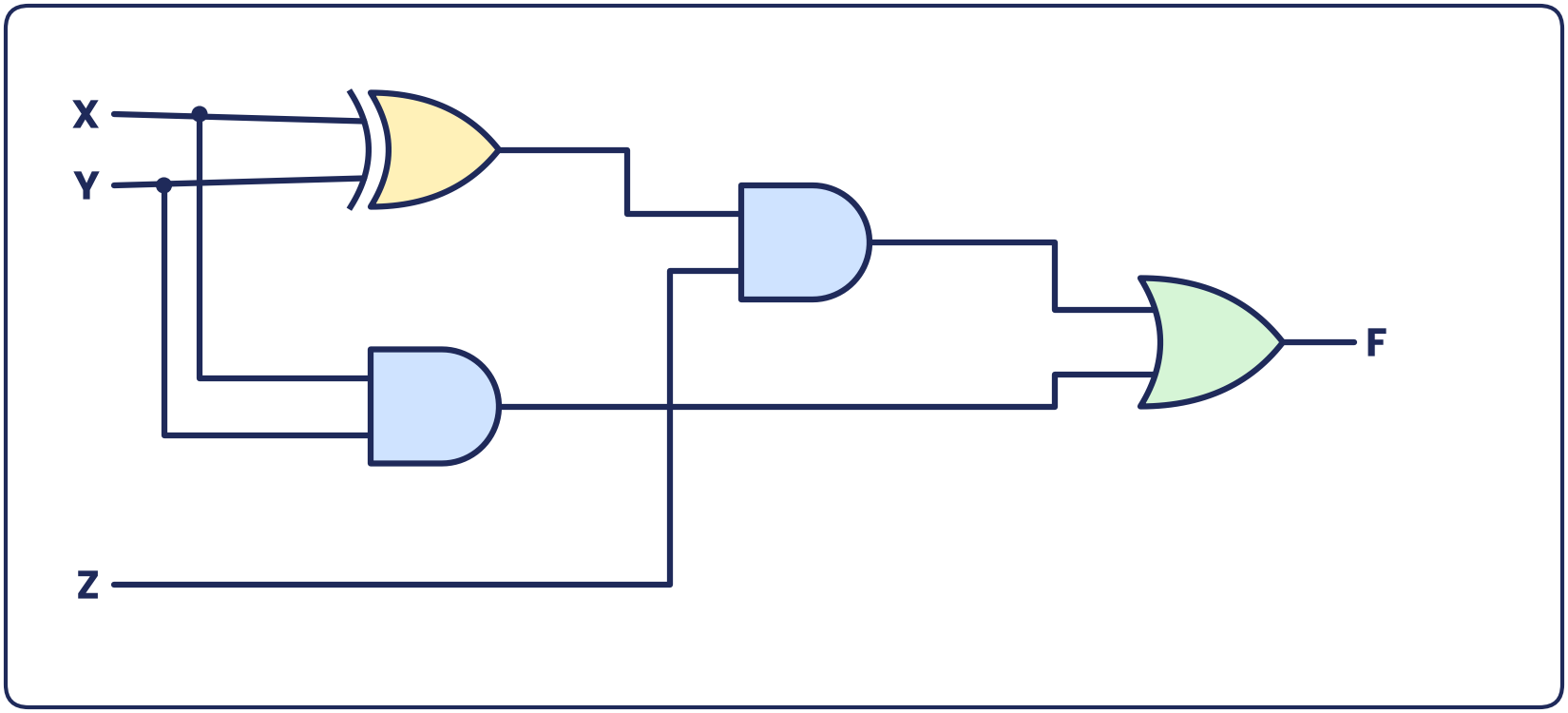
| X Y Z | F | |||
|---|---|---|---|---|
| 000 | 0 | 0 | 0 | 0 |
| 001 | 0 | 0 | 0 | 0 |
| 010 | 1 | 0 | 0 | 0 |
| 011 | 1 | 1 | 0 | 1 |
| 100 | 1 | 0 | 0 | 0 |
| 101 | 1 | 1 | 0 | 1 |
| 110 | 0 | 0 | 1 | 1 |
| 111 | 0 | 0 | 1 | 1 |
Question: Three AND gates feed an OR → Y. AND1 = . AND2 = . AND3 = . Inputs are uniformly random. ? (The 2026 paper asks .)
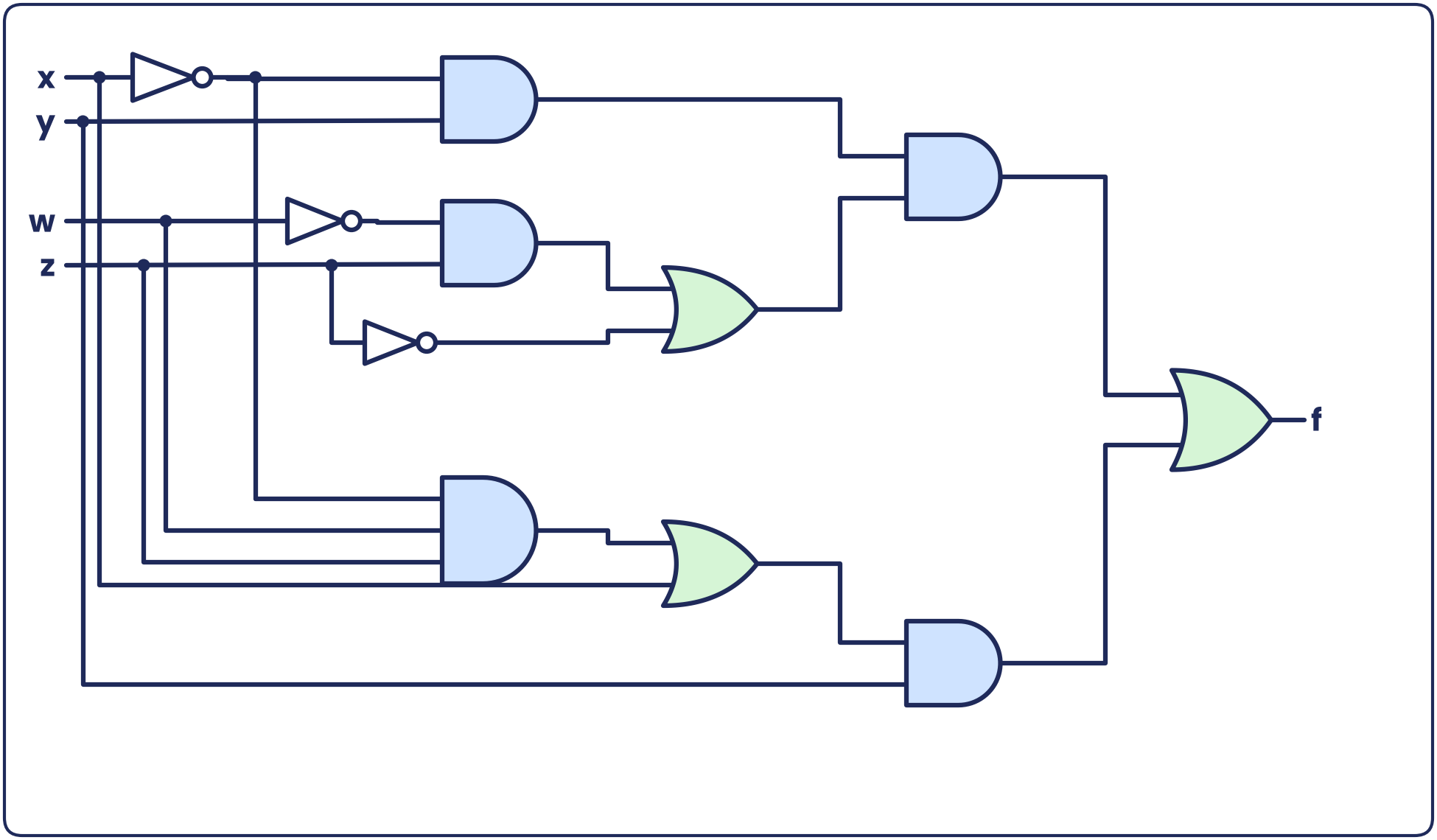
Question: A 4-input circuit (x, y, w, z) with five AND gates, two OR gates and three NOT gates. ?
| Count of 1s | Rows (3 variables) |
|---|---|
| 0 ones | 0 (000) |
| 1 one | 1 (001), 2 (010), 4 (100) |
| 2 ones | 3 (011), 5 (101), 6 (110) |
| 3 ones | 7 (111) |
Quick facts: (odd number of 1s). its opposite (even number of 1s).
Question: . For which condition is f always 1? Options: 2 or more inputs at 0 / 2 or more inputs at 1 / any odd number of inputs at 0 / any odd number of inputs at 1
Question: . For which condition is f always 1? Options: exactly one input at 1 / all inputs at 1 / any two inputs at 0 / any even number of inputs at 1
Question: . For which condition is f always 1? Options: 2 or more inputs at 0 / 2 or more inputs at 1 / any odd number of inputs at 0 / any odd number of inputs at 1
Question: Given , which statement is always true? Options: / None of these
Each row where is one minterm. Count the rows. For “exactly k of n inputs”, use ⁿCₖ = n! ÷ (k! × (n − k)!).
Level 1: exactly one 1 among 3 inputs → ³C₁ = 3 (001, 010, 100). Level 2: exactly two 1s among 4 inputs → ⁴C₂ = (4 × 3) ÷ (2 × 1) = 6.
Question: A circuit has inputs A, B, C, D. if and only if exactly two of the four inputs are 0 (the AN paper says “are 1”). Minimum number of minterms in the SOP for F?
Level 1: . B is missing → rows . Level 2: . C is missing → .
Question: Find the minterms of .
Question: Find the minterms of .
For each row, put the values into each product term. If any term is .
Question: Choose the correct truth table for .
Test each identity with numbers. One row that gives different sides proves it wrong. If it survives all rows, it is right.
| True identity | Name |
|---|---|
| distributive (OR over AND) | |
| ’ = A’·B’ | De Morgan |
| ’ = ’B’ | XNOR |
| cancels |
Question: Choose the correct identities: ’ = ’B’ / ’ = A’ + B’ /
Question: Choose the correct option: ’ =
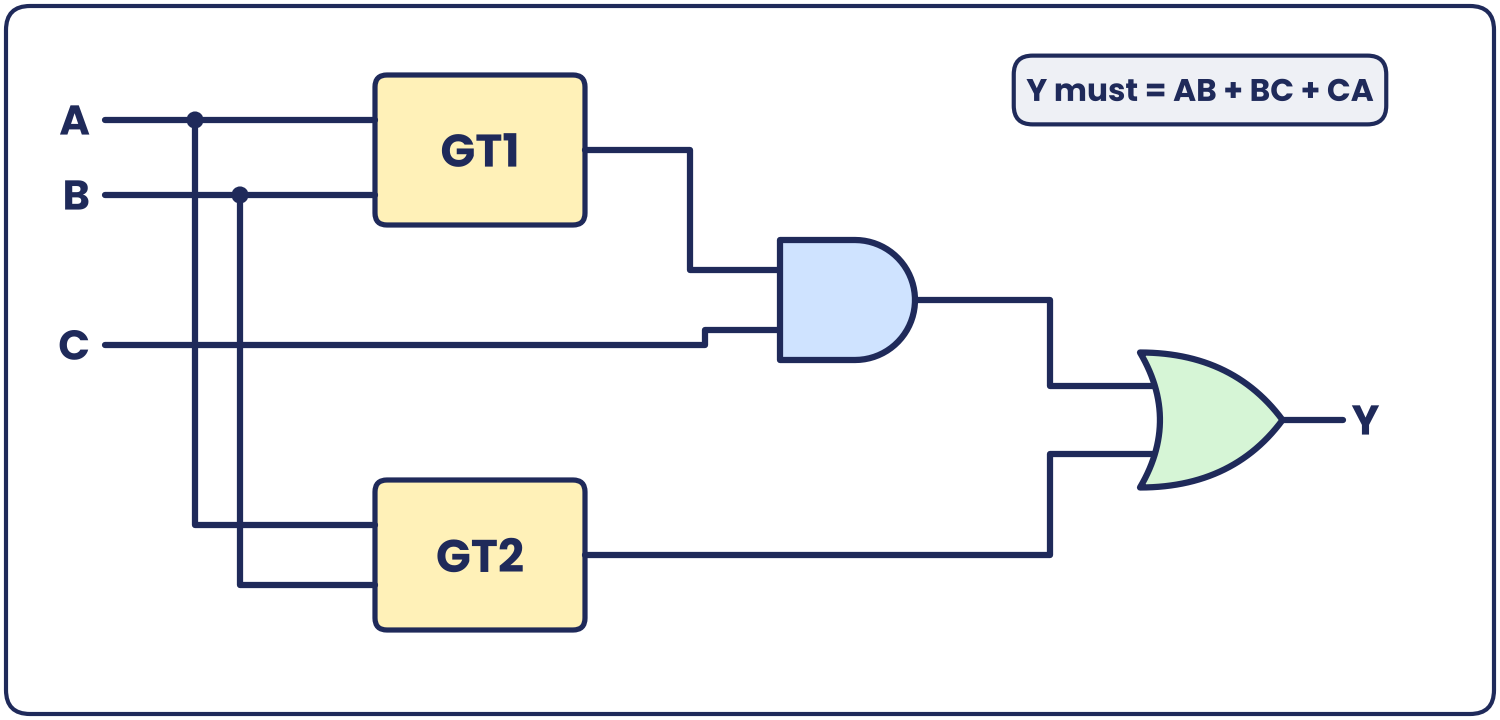
Question: Y must equal . A and B go into GT1. GT1’s output and C go into an AND. A and B also go into GT2. The AND output and GT2’s output go into an OR → Y. What are GT1 and GT2?
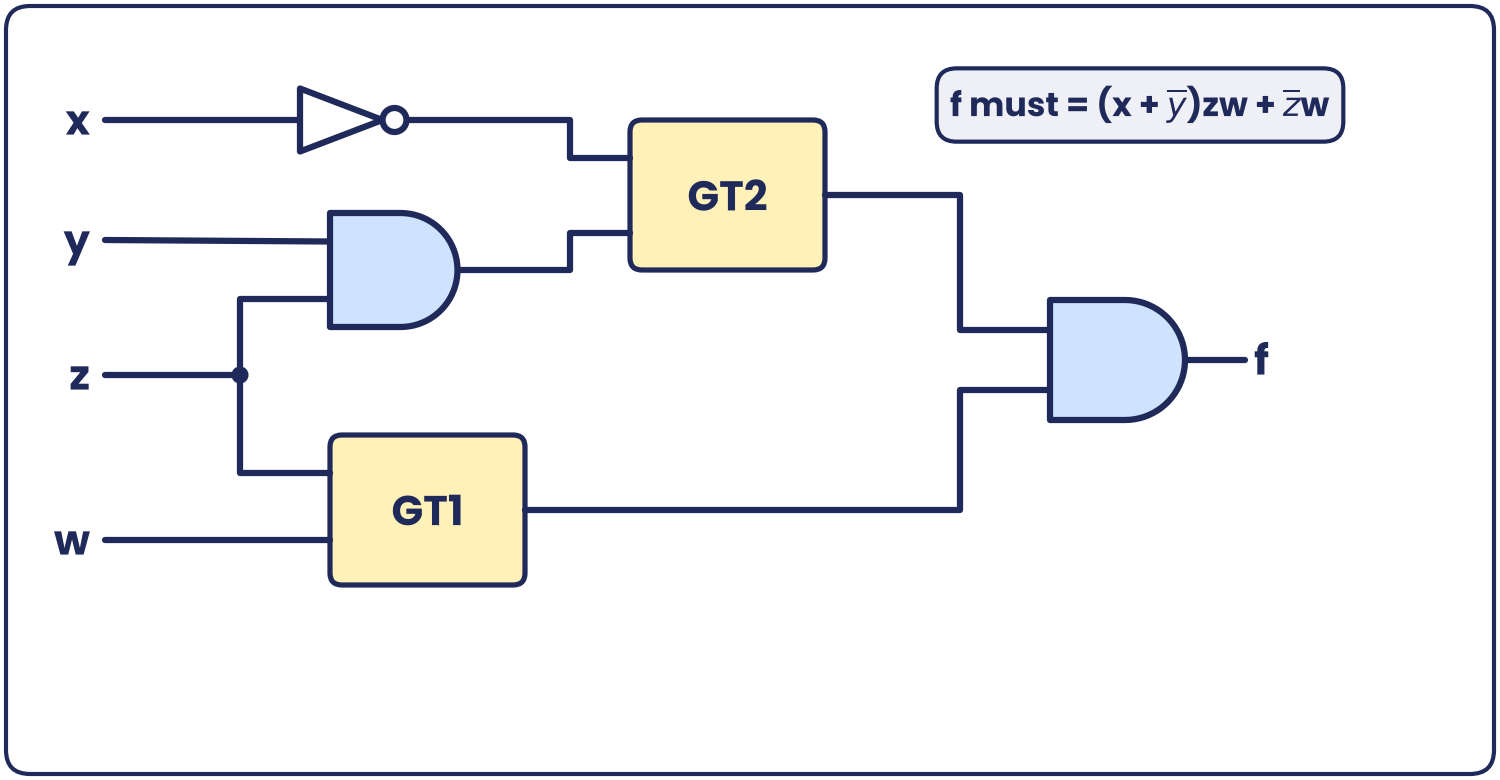
Question: f must be . x goes through a NOT into GT2. y and z go into an AND, whose output also goes into GT2. z and w go into GT1. GT1 and GT2 go into a final AND → f.
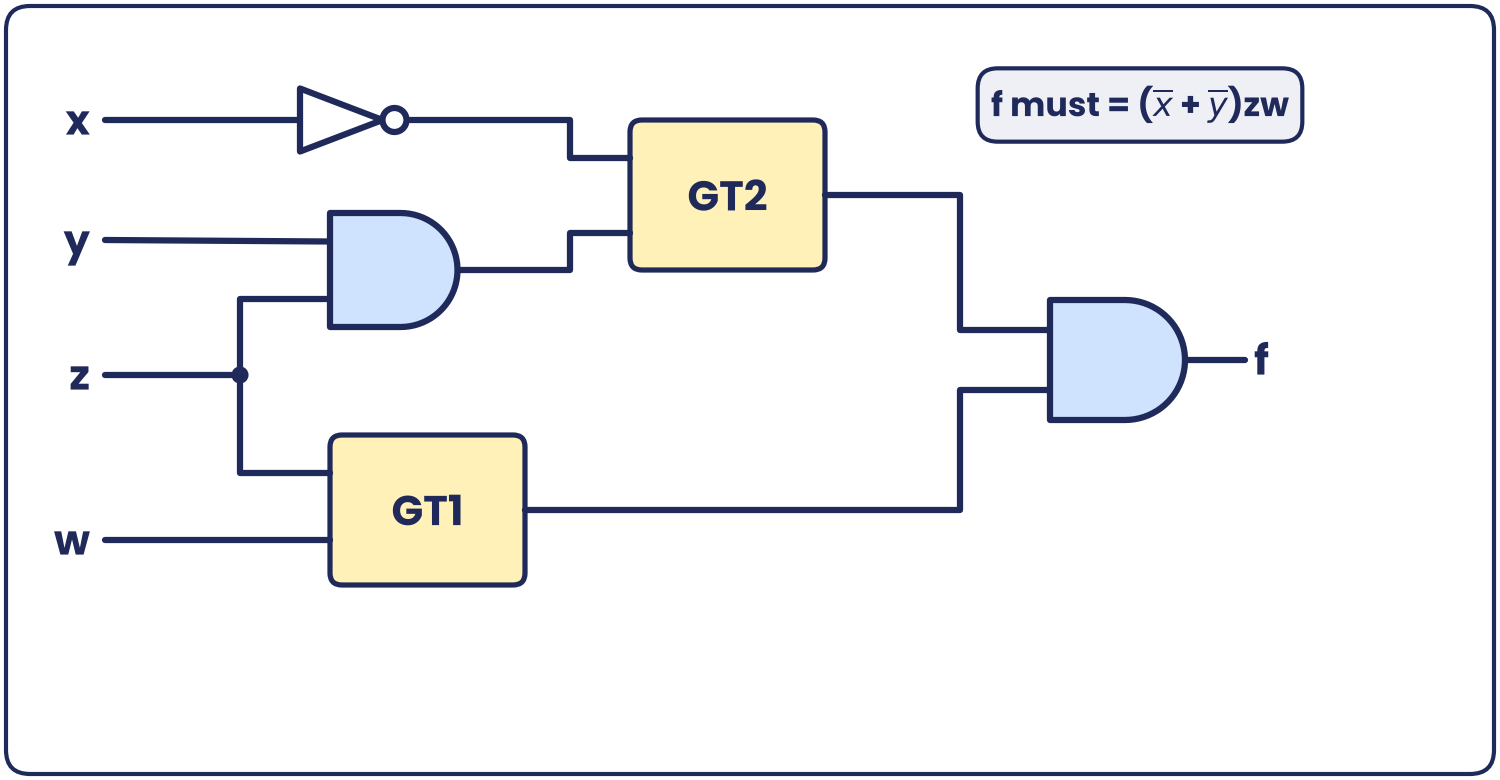
Question: Same circuit, f must be .
Question: “Sequential circuits do not utilize feedback loops, while combinational circuits do.” True or False?
it’s the other way round. Sequential circuits use feedback (that’s how they remember). Combinational circuits have no feedback and no memory.
In one line: Push values through gate chains, simplify before counting probability, test every option row by row, and remember the papers’ Week 2 keys were wrong three times. Exam words: gate chain, uniformly random, probability, , parity, ⁿCₖ, minterm list, Boolean identity, missing gate, feedback.